

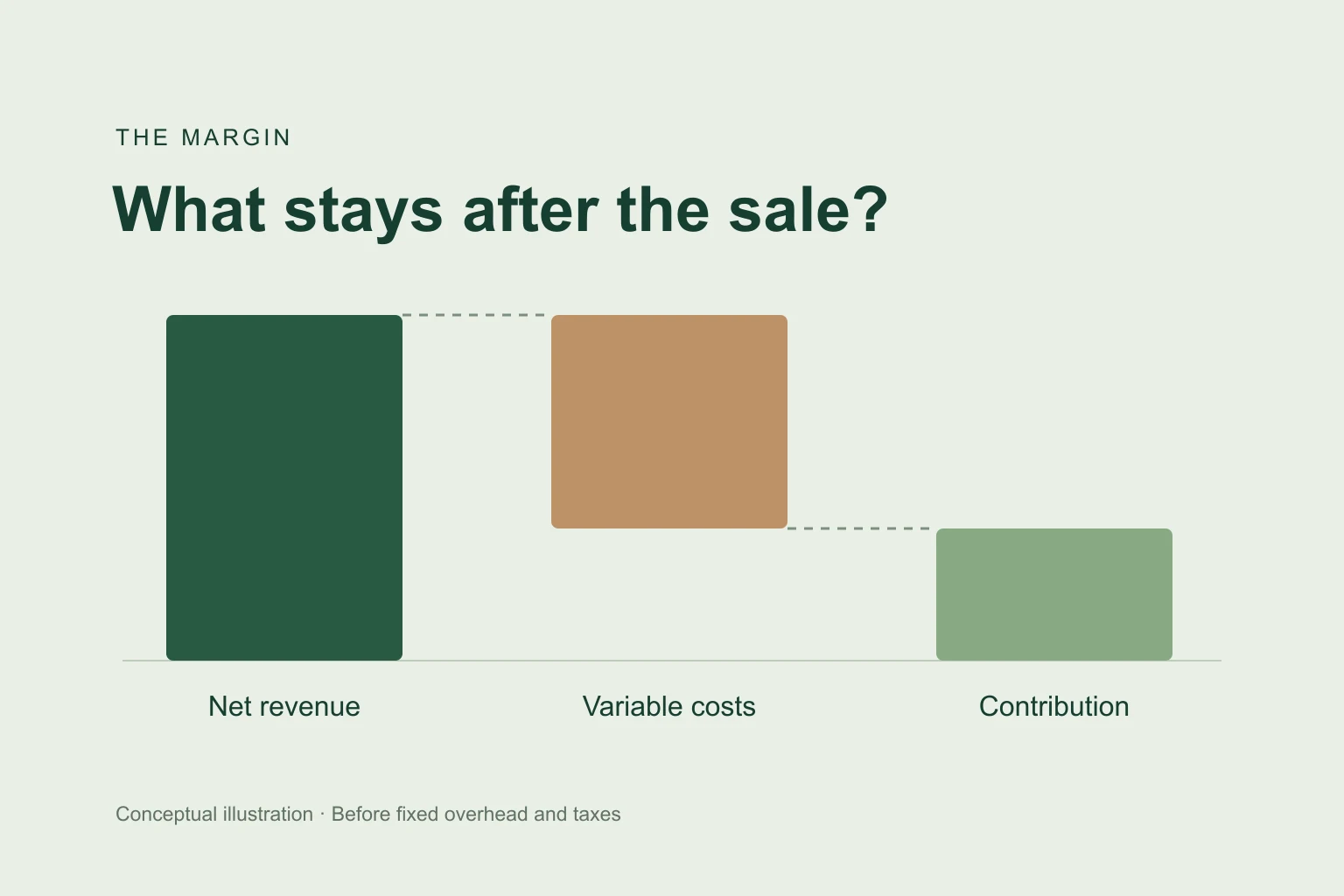
Calculate contribution with explicit cost assumptions. Revenue, platform payout, and profit answer different questions.
A strong sales week can feel like proof that the business is working. Then the next stock order, advertising invoice, and refund batch arrive, and the bank balance tells a different story. The problem may be poor margins, timing, or a mixture of both. You need a calculation that separates those explanations.
Start with one product and one clearly defined period. Use actual order and cost records where available. Mark estimates as estimates, and leave missing information visible. A margin calculation that quietly treats unknown costs as zero can be more misleading than having no calculation at all.
Sales are the beginning of the calculation
- Net revenue
Start with a clearly defined sales basis after reductions.
- Product & fulfillment
Account for goods, packaging and delivery costs.
- Fees & advertising
Include applicable fees, commissions and ad spend.
- Contribution
What remains before fixed overhead and taxes.
Define the question before choosing a number
Revenue describes sales under a particular reporting definition. A payout describes money transferred after the platform’s settlement process. Gross profit and contribution describe what remains after specified costs. Net business profit goes further, including overhead and other relevant expenses. The labels matter because each number supports a different decision.
For a campaign decision, contribution after variable costs is often a useful starting point. For a cash decision, use expected receipts and payments. For formal financial reporting, align definitions with your accounting process. Do not relabel a convenient dashboard total “profit” without explaining what it includes and excludes.
Work from a transparent order example
The figures below are hypothetical operating assumptions, not TikTok’s published fee rates. Sales tax, overhead, and financing costs are outside this simplified example. The $30 starting point is assumed to be the amount retained as product revenue after seller-funded discounts, before the deductions shown.
| Item | Amount per order |
|---|---|
| Product revenue | $30.00 |
| Product cost | −$9.00 |
| Packaging and fulfillment | −$4.00 |
| Platform fees assumed for this example | −$2.00 |
| Creator commission | −$3.00 |
| Advertising allocation | −$5.00 |
| Expected net returns cost | −$1.00 |
| Contribution before overhead | $6.00 |
That is a 20% contribution margin on the assumed $30 revenue. If advertising allocation rises from $5 to $8, contribution falls to $3, or 10%, with everything else unchanged. The product can produce the same revenue while leaving half as much money to cover the rest of the business.
Treat COGS as a dated input
The amount it costs to buy or make a unit can change with supplier pricing, freight, duties, or product composition. Decide which costs your COGS definition includes and apply it consistently. Do not add the same freight amount once in landed product cost and again as a separate expense in the same calculation.
Preserve the cost relevant to the period being analyzed. If a new supplier quote applies only to future purchases, applying it to every past order can rewrite the history you are using to make a decision. If the historical cost is genuinely wrong, document the correction and which results change.
Bundles need special attention. A bundle with three components should carry the relevant component costs plus any additional assembly or packaging cost under your chosen definition. A missing component cost is still missing data even when the other two are known. Show that limitation rather than presenting an apparently precise bundle margin.
Avoid counting costs twice
TikTok provides settlement reports through Seller Center’s Finance exports. Use the transaction detail to understand which fees and adjustments are already reflected in the platform amounts you are using. A payout figure is not a clean substitute for order revenue when constructing an independent margin calculation. [1] TikTok Shop US — How to Access Your Settlement Report
The same principle applies to refunds. If you have already reduced revenue for a refunded order, do not subtract the refunded selling price a second time as a returns expense. Separate retained fees, return freight, recoverable inventory, and other costs according to the records available. Reconcile estimates to actual outcomes once the return is resolved.
Allocate advertising honestly
Not every ad dollar maps cleanly to one order. If you allocate spend across products or days, describe the method and retain a shop-level view of total spend. A product can appear highly profitable simply because its advertising cost was left on another row. Attribution reports and expense allocation are different tasks.
Use sensitivity analysis when the allocation is uncertain. Calculate contribution under several plausible spend assumptions. If the product is unattractive in most of them, the issue deserves attention before scaling. If the decision changes with a small assumption, improve the data before making a large commitment.
Review the products that change the answer
Sort by total contribution as well as contribution per order. A low-volume item with an excellent percentage may contribute less cash than a high-volume item with a modest margin. Also review negative-contribution products, missing costs, and products whose results changed sharply after a promotion or supplier change.
Finish with a decision: adjust a promotion, investigate a charge, update a cost, improve fulfillment efficiency, or keep the current approach. Keep overhead and cash needs visible alongside the product analysis. Growing sales becomes much more useful when you can explain what the business retains from that growth—and which assumptions still need to be checked.
Sources & further reading
Platform facts are linked above. Examples and operating recommendations are Ruleo’s analysis. Sources checked October 7, 2026.