

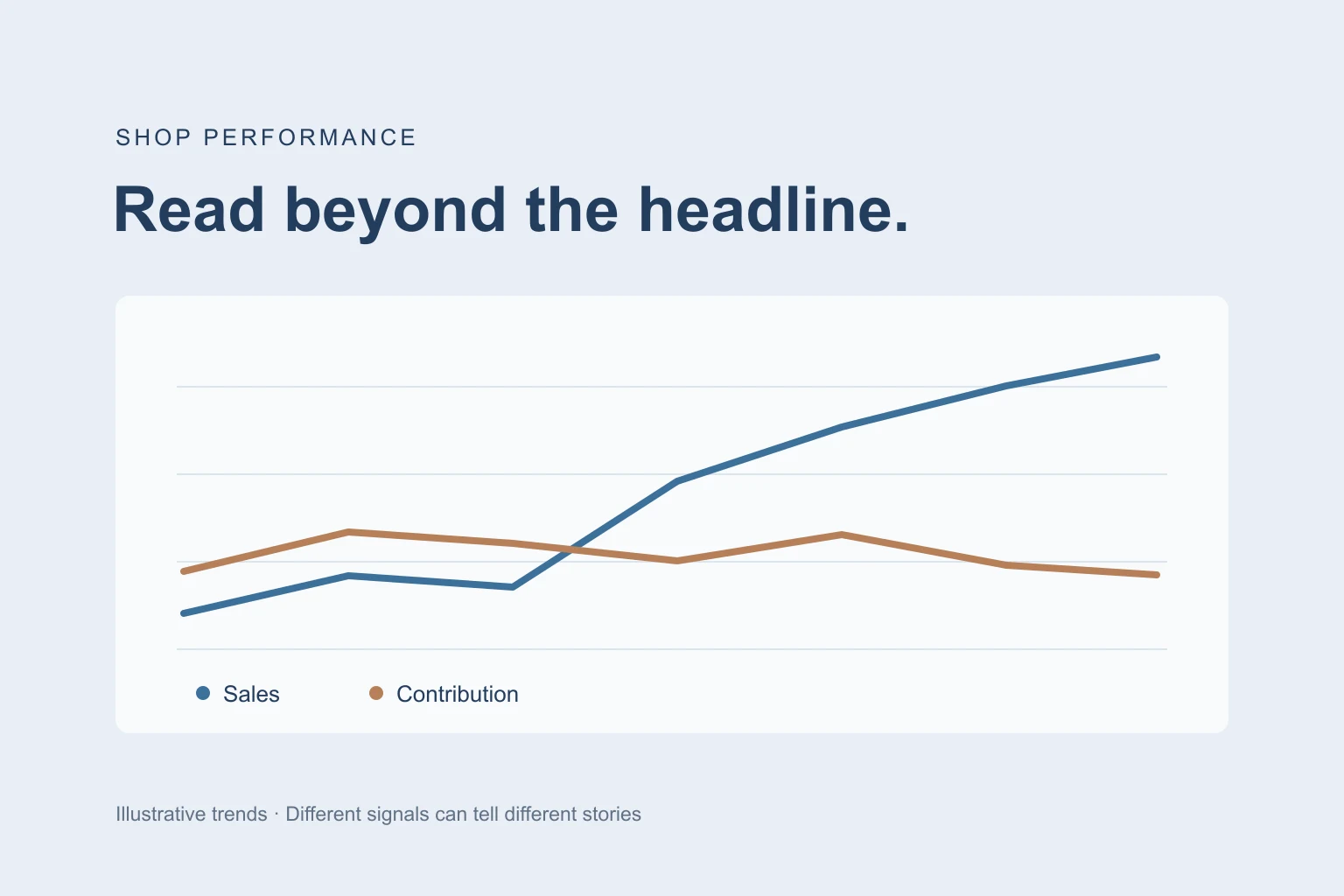
Follow a weak metric back to the affected orders and a controllable cause. Improving the number starts with improving the experience it represents.
A declining score tells you something changed. It does not, by itself, tell you which process to fix. Teams lose time when they stare at the headline number, compare it with another shop, and search for a shortcut. The more productive question is which orders, products, or customer interactions explain the movement.
A performance review should translate a signal into a decision. That requires understanding the metric’s definition, checking the relevant evidence, and choosing an intervention you can control. This guide offers a working method for that investigation rather than a list of thresholds that may become outdated or differ across categories.
Read the definition before reading the trend
- Population
Which orders or cases are included?
- Window
Which dates and time zone apply?
- Calculation
What are the numerator and denominator?
- Evidence
Which underlying records explain the change?
Know which measure you are looking at
TikTok’s US SPS guide organizes Shop Performance Score around product satisfaction, fulfillment and logistics, and customer service. It describes category benchmarks, metric-level diagnosis, and priority opportunities. Use the current Seller Center view for the definitions and comparisons applicable to your shop. [1] TikTok Shop US — Guide to Shop Performance Score
Do not assume every operational metric is a component of SPS. Account-health indicators, fulfillment requirements, and your own internal service measures may overlap in purpose while remaining distinct. Keep their names and definitions separate in reports so a team does not claim to have fixed one by moving another.
TikTok’s Late Dispatch Rate requirements explicitly state that LDR does not directly impact SPS. That does not make dispatch unimportant; it illustrates why a seller should distinguish a platform requirement from the composition of a particular score. [2] TikTok Shop US — Late Dispatch Rate Requirements
Check the denominator and the time window
Before interpreting a percentage, write down what counts in the numerator and denominator, when an order enters the calculation, and which exclusions apply. Ten late orders among 100 and ten among 1,000 are different rates. Orders placed this week may not belong to the same cohort as orders delivered this week.
A small number of new outcomes can move a small shop’s rate substantially. Conversely, a larger historical window may change slowly even after today’s process improves. Neither pattern automatically proves that the dashboard is wrong. Compare the metric with the underlying orders before deciding whether the change is operational or a reporting misunderstanding.
Use the diagnostic path to reach specific cases
The SPS guide describes drilling into metrics and their problematic orders, products, or conversations. It also notes that category benchmarks vary. Use that evidence to prioritize work rather than treating another seller’s screenshot as a universal target for your business. [1] TikTok Shop US — Guide to Shop Performance Score
Read several affected cases. Are cancellations concentrated in one variant? Are delivery misses concentrated on one carrier lane? Are negative reviews about product quality or a mismatch in expectations? A shop-level average can hide the cluster where a small, specific change would do more than a broad initiative.
Separate cause, symptom, and proposed fix
Suppose an internal review finds eight cancellations on one SKU. “Cancellations increased” is the symptom. “Inventory was overstated after stock was reserved elsewhere” is a possible cause. “Reconcile reservations before the promotion” is a proposed fix. Each step needs evidence; jumping straight from the first to the third can waste effort.
Keep a short investigation record. Include the affected cohort, the evidence checked, the uncertainty, the proposed action, and when you will reassess. If the data is incomplete, say so. A useful operational hypothesis does not need to be presented as a proven explanation in order to justify a small, reversible improvement.
Pair lagging outcomes with leading checks
A returned product or missed delivery has already happened. You still need to resolve the case, but prevention often depends on a signal available earlier. Match each outcome with something the team can inspect while there is time to act.
| Outcome to investigate | Earlier operational check |
|---|---|
| Cancellations associated with stock | Available stock versus reservations by variant |
| Late delivery cluster | Packing backlog and carrier acceptance events |
| Missing-component complaints | Bundle assembly and packing verification |
| Repeated unanswered inquiries | Oldest unresolved conversation and staffing coverage |
| Product-expectation complaints | Accuracy of dimensions, quantity, and demonstrations |
These pairings are suggested internal checks, not a replacement for official metric definitions. They help a team move from retrospectively reporting harm to reducing the chance of the next occurrence. Start with a check someone can maintain reliably before adding more alerts.
Evaluate the intervention on a fair comparison
Record when the change took effect and which orders it should influence. Give those orders time to complete the relevant journey. Compare similar products and fulfillment conditions, and watch for changes in volume or traffic mix that may explain the result. Show the case count alongside any percentage change.
A successful intervention should improve the underlying customer outcome, not merely make a local report look better. If a rate appears to improve because difficult cases were excluded from an internal spreadsheet, the operation has not improved. Keep platform measurements intact and document any separate analytical view clearly.
End with an owner and a checkpoint
A useful review ends with a concrete statement: the inventory lead will verify a variant’s reservations today, or the logistics lead will investigate a carrier lane before the next dispatch cycle. Recheck both the process and the subsequent outcomes. Over time, the score becomes a summary of an operation the team understands rather than a number everyone hopes will recover.
Sources & further reading
Platform facts are linked above. Examples and operating recommendations are Ruleo’s analysis. Sources checked October 7, 2026.