

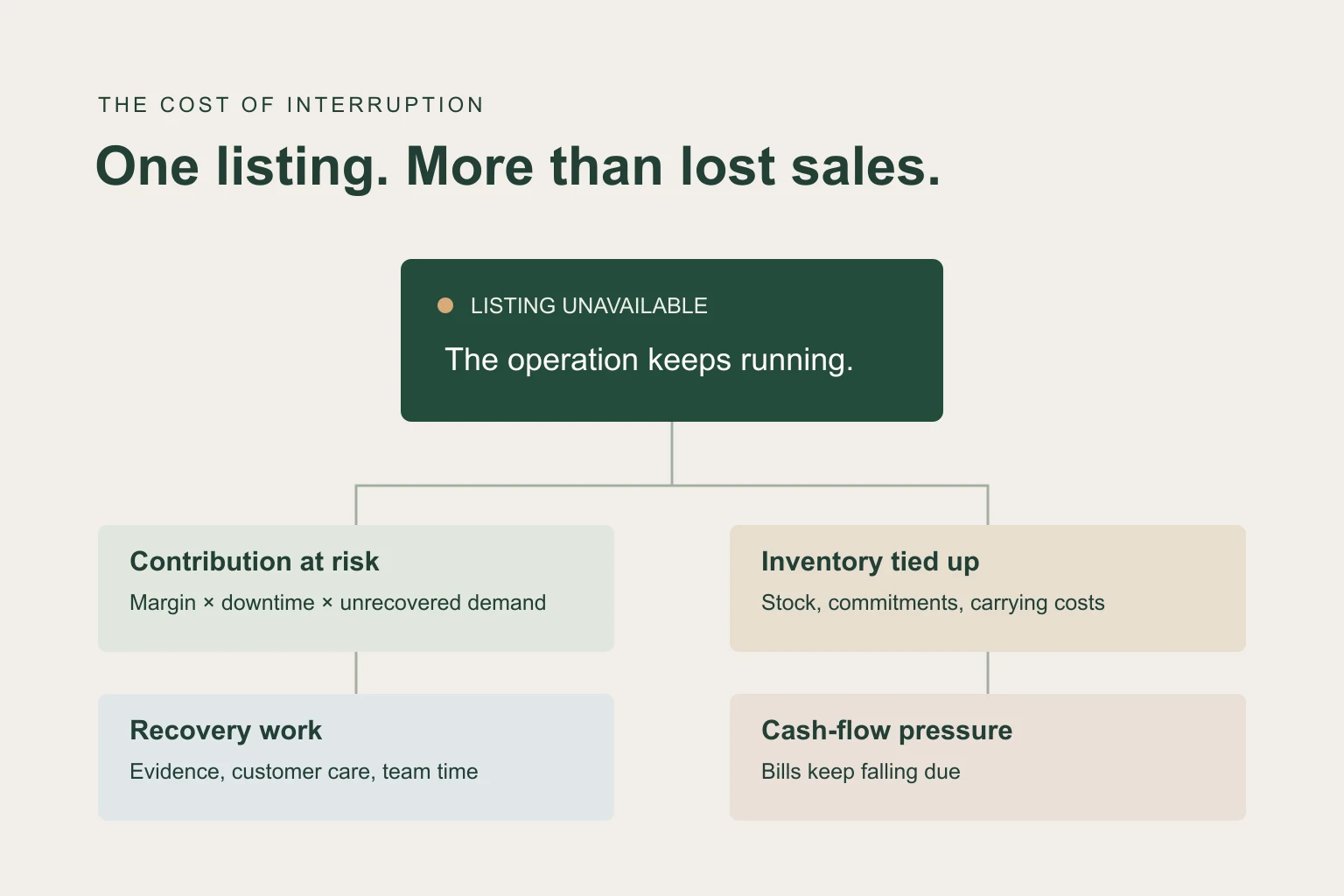
Treat listing health as an operating responsibility. Connect warning signs to the product, the money exposed, and a named next action—while keeping confirmed enforcement separate from suspected risk.
A bestseller goes unavailable. The sales chart falls, but the warehouse still holds stock, a supplier still expects payment, and the team still has to answer customers. The visible interruption is a product page. The operational problem stretches across the business.
A listing takedown deserves the same attention as a fulfillment failure or an unexplained settlement deduction. The question is not simply whether a seller can win an appeal. It is how quickly the team recognizes the problem, understands what is affected, and takes the right action without creating another one.
Separate exposure from actual loss
- Contribution
Model downtime and purchases recovered later.
- Incremental costs
Count incident costs once, net of recoveries.
- Capital exposed
Track inventory and liquidity separately.
- Next action
Name an owner and the actual deadline.
Approval is the beginning of monitoring
TikTok Shop can review a product after it is already selling. Its US Product Safety and Compliance Policy says safety complaints or reports can prompt a listing review, requests for supporting documentation, and temporary or permanent suspension. Sellers must respond promptly to information requests; failing to do so can lead to further enforcement. Earlier listing approval does not end those responsibilities. [1] TikTok Shop US — Product Safety and Compliance Policy (August 2026)
This does not mean every complaint becomes a takedown, or that rapid growth is evidence of wrongdoing. A complaint is a signal to investigate. A platform notice is evidence of a specific action. Keeping those separate prevents both complacency and unnecessary panic.
| Situation | What the operator needs to establish |
|---|---|
| Product review or rejected edit | Which version is under review, and whether the existing listing remains available. |
| Listing frozen or removed | The affected products or variants, the stated reason, and the required response. |
| Shop restriction or deactivation | The scope across listings, orders, selling permissions, and access to funds. |
What the research tells us—and what it cannot
Amazon’s Trustworthy Shopping Experience Report covering 2025 describes continuous monitoring throughout a seller’s journey, including billions of attempted product-page changes scanned daily. Amazon also acknowledges that protective policies can create friction for legitimate sellers. Its report describes direct verification with accredited safety laboratories. Compliance is an ongoing operating responsibility, even on an established marketplace. [2] Amazon — Trustworthy Shopping Experience Report: findings for 2025
This is a recent platform report, not an independent survey of seller losses. It does not establish how frequently legitimate sellers experience mistaken takedowns, and its figures should not be treated as a TikTok risk estimate. Its relevance is the operating model: checks continue after onboarding and publication. The costs below are Ruleo’s scenario analysis, not measured averages from the report.
The costs extend beyond the missing sales
The following are potential consequences to assess, not charges that automatically follow every takedown. Their size depends on the affected product, the reason for enforcement, the duration, and the shop’s ability to respond.
| Exposure | Measure it | Act on it |
|---|---|---|
| Lost contribution | Daily contribution × downtime × unrecovered demand. | Prioritize margin at risk, not just sales. |
| Stock & commitments | Capital tied up; incremental carrying cost; net write-down. | Check purchase orders, shelf life and safe disposition. |
| Commercial spend | Unrecoverable commitments + wasted spend − credits. | Check delivery; pause or reschedule where possible. |
| Customer resolution | Net refunds, replacements, return freight and extra support. | Reconcile affected orders and recoveries once. |
| Recovery work | Extra fees and staff time; post-restoration sales gap. | Assign an owner; gather the exact evidence. |
| Liquidity | Cash due before receipts − available cash. | Reforecast funding needs separately from losses. |
Existing orders need a separate review. Record their actual status, the instructions in the notice, and any customer obligations. Do not assume that a listing removal means every order has been canceled—or that goods already dispatched are financially settled.
A return, refund, missed sale, and delayed payout are different accounting events. Counting them all as lost revenue can dramatically overstate the damage. Likewise, inventory that remains safely sellable is capital tied up, not necessarily a write-off. Any alternative sales route must be lawful and consistent with the product’s safety status; moving an unsafe item elsewhere does not resolve the problem.
Model the duration, the recovery rate, and the cash separately
Take a hypothetical product with normal sales of $2,000 a day, a 25% contribution margin after variable costs, and $12,000 of affected stock at landed cost. Assume 20% of displaced purchases are recovered later at the same margin. The remaining contribution exposure is $400 per unavailable day: $2,000 × 25% × 80%. These are planning assumptions, not typical seller outcomes.
| Exposure | 2 days | 7 days | 14 days |
|---|---|---|---|
| Sales displaced | $4,000 | $14,000 | $28,000 |
| Contribution forgone¹ | $800 | $2,800 | $5,600 |
| Extra cash costs² | $300 | $900 | $1,800 |
| Modeled impact | $1,100 | $3,700 | $7,400 |
| Stock capital³ | $12,000 | $12,000 | $12,000 |
¹ Assumes 20% of purchases return later at the same margin. ² Illustrative response and carrying costs. ³ Capital exposed, not added to modeled loss.
In this model, a seven-day interruption puts $14,000 of sales in question but produces a $3,700 economic impact—not $14,000 plus $3,700 plus the stock value. The additional cash costs are illustrative scenario inputs, not a platform tariff. The model excludes any further inventory write-down, existing-order remediation, financing cost, or post-restoration loss; add those only when supported and not already counted.
Recovery assumptions matter as much as duration. At seven days, contribution forgone is $3,500 if no purchases return, $2,800 if 20% return, and $1,750 if half return. Each avoidable day costs $400 in contribution under the base case, before extra incident costs. Earlier action can reduce internal delay; it cannot guarantee a shorter platform review. Use ordinary trading and realistic demand ranges rather than extrapolating a single viral day.
Earlier risk detection starts with ordinary operating signals
A useful monitoring routine looks for issues a team can investigate and address, rather than trying to predict a secret enforcement score. Prioritize products with material sales or contribution exposure, but escalate credible safety concerns regardless of revenue.
- Repeated complaints about the same defect, missing component, inaccurate description, or safety concern. Compare counts with orders and inspect the underlying cases.
- Product documents that are missing, outdated where expiry applies, or do not clearly match the item, variant, or supplier being used.
- Changes to materials, suppliers, packaging, claims, or listing content that have not been checked against the product evidence.
- Fulfillment pressure after a demand spike: overdue handoffs, unclear carrier acceptance, or a growing queue of unresolved buyer issues.
- An official information request, rejected review, frozen listing, or changed shop status that has no named owner or next checkpoint.
These signals are not interchangeable. A missing document can be addressed before a request arrives. A platform status event may tell you about an action already taken. Call the first risk detection and the second incident detection; both matter, but only one is an advance warning.
Catch issues sooner and act faster with Ruleo
Example: listing frozen
Signal received- Product
- Example SKU 1042
- Reason
- Platform reason, if supplied
- Time
- Event timestamp
- Record
- Signal ID + workflow run
Queue immediately after the signal matches. Delivery depends on the channel.
Example notifications queuedWhat about action modes?
Notifications do not need approval. These modes apply to actions that change the shop.
For a shop-changing action: request approval before proceeding. This is the default. Test runs simulate every mode.
Ruleo’s workflow automations help turn available shop signals into timely action. Instead of depending on someone to notice a problem during the next dashboard review, a workflow can respond when a configured condition is met. Catching an issue sooner gives the team more time to investigate, correct what is within its control, and prevent a manageable problem from escalating.
For a configured notification workflow, the intended response is immediate routing to whichever supported channels the seller has enabled, such as Slack or email. The notification should identify the affected product, the available reason, and the event time so the team can begin investigating. Immediate routing means acting when the signal is received; it does not mean TikTok supplies every warning in advance or that an external channel guarantees instant delivery.
That speed matters before and after enforcement. Before an adverse action, recognizing an unresolved operating issue and acting on it can help prevent avoidable restrictions on the shop. After a listing is affected, a quicker response can reduce preventable downtime and further revenue leakage. The useful sequence is simple: detect the signal, understand the business exposure, and move the required action forward.
For sellers and agencies, the value is less time between a developing issue and a considered response. Workflow automation supports that response using the signals and actions available to the connected shop. It cannot guarantee advance notice of every violation or control TikTok’s enforcement decisions, but it can help remove the internal delays that make an incident more expensive.
When a listing is removed, make the response specific
- Preserve the notice, affected product identifiers, listing version, timestamps, and available reason. Establish the scope before making changes.
- Investigate the actual concern. If safety is in question, prioritize protecting customers and affected inventory; restoration is not the first objective.
- Assign an owner and record the deadline shown in the notice. Collect the evidence requested for this product and issue, rather than submitting a generic explanation.
- Review open orders, planned activity, stock commitments, and financial exposure separately. Follow the applicable platform instructions.
- Confirm the outcome in the actual listing and shop records. Record what caused the incident and what changed to reduce recurrence.
For safety appeals, TikTok may require proof of safety and a corrective action plan. Supporting documents must match the product concerned, and generic promises to improve are insufficient. Record the deadline and evidence requirements in the actual notice; a well-organized response should address the identified concern. [1] TikTok Shop US — Product Safety and Compliance Policy (August 2026)
Protecting revenue starts before the sales chart falls. Ruleo’s workflow automations help teams recognize issues sooner and take quicker action, reducing the opportunity for unresolved problems to become adverse shop actions or avoidable revenue leakage. The aim is to keep the operation moving, with less time lost between knowing something is wrong and doing something about it.
Sources & further reading
Platform facts are linked above. Examples and operating recommendations are Ruleo’s analysis. Sources checked October 13, 2026.